Is Electric Drive Axle the Future Trend of Electric Heavy-Duty Trucks?
Unlike fuel heavy-duty trucks with mature technologies, core technologies of electric heavy-duty trucks are constantly improved in practical applications – and electric drive axle is one of the most representative parts.
In recent years, a clear industry trend has emerged: the central drive system, which almost monopolized the driving form of electric heavy-duty trucks in the early years, is being rapidly replaced by highly integrated electric drive axle technology.
Many industry insiders believe that electric truck axle will replace central drive on a large scale in the future and become the mainstream technical route for electric heavy-duty trucks.
Central Drive System vs Electric Drive Axle
Traditional electric heavy-duty trucks mostly adopt the central drive system: a distributed architecture of "central motor + drive shaft + axle".
The working principle of the central drive system is similar to that of traditional fuel vehicles. An independent motor is arranged on the chassis, and power is transmitted to the drive axle through the drive shaft.
This structure has many mechanical parts and a long transmission path, resulting in serious energy loss and many inherent defects.
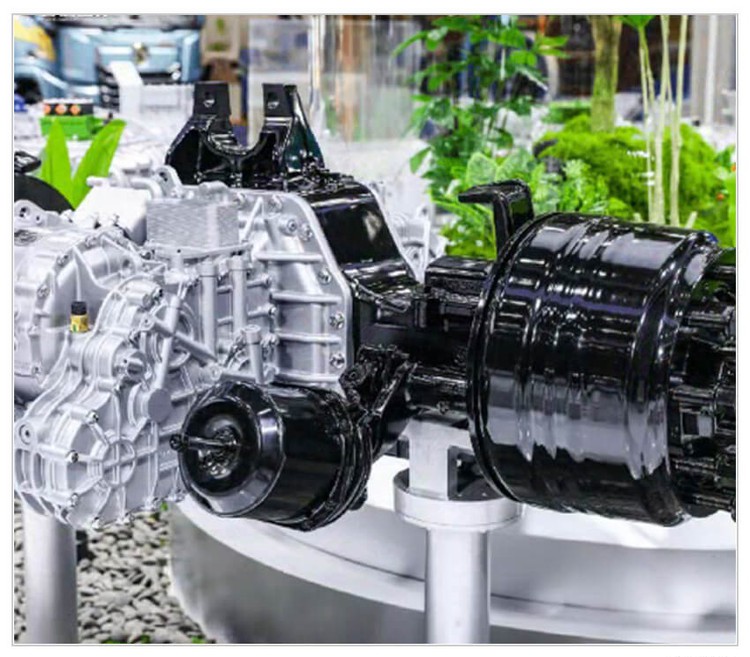
E axle system technology adopts a highly integrated design, which integrates the motor, transmission, differential and other core components inside the axle, cancels the drive shaft, realizes direct power drive, and greatly shortens the power transmission path.
What Are the Advantages? Why Will Electric Drive Axle Become the Mainstream?
The most prominent advantage of the integrated design of electric drive axle is the shortened power transmission path. It simplifies the traditional architecture from "motor → drive shaft → main reducer → wheels" to "motor → reducer → wheels", which greatly improves transmission efficiency.
The improvement of energy efficiency directly brings higher operating income for users. Take a pure electric heavy-duty truck as an example: it is equipped with TRION's innovative 4-in-1 integrated electric drive axle, which integrates the motor, gearbox, PTO and axle into one unit. With a more compact structure and optimized power transmission path, it brings significant advantages of higher overall efficiency and lower power consumption.
Based on an annual average driving mileage of 140,000 kilometers and an electricity price of 0.8 yuan per kWh, this electric drive axle can save users up to 33,600 yuan in electricity costs every year.
At the same time, the traditional central motor occupies a lot of space behind the cab, while electric drive axle can be directly integrated at the axle end, freeing up more space for battery arrangement and cargo loading.
More importantly, the "second half" competition of new energy vehicles focuses on intelligence, and electric drive axle has greater advantages in this field.
Its integrated structure is easier to connect to the vehicle's intelligent control system, laying a foundation for advanced driver assistance systems, intelligent energy recovery and other high-end functions.
Intense Market Competition with Multiple Players
As the trend of electric drive axle continues to grow, more and more players have entered the market.
The first category is rapidly rising third-party suppliers, represented by enterprises such as TRION Shanghai. These enterprises are currently the main force in the heavy-duty truck electric drive axle market.
The second category is actively transforming traditional manufacturers, including traditional supporting enterprises and vehicle manufacturers such as Sinotruk.
The third category is new heavy-duty truck forces with self-developed electric drive axles, such as Deepway.
The fourth category is global giants dominating the high-end market, such as ZF and other international brands. They lead the high-end market with integrated systems like modular electric drive axles.
Driven by these enterprises, heavy-duty truck electric drive axle technology is accelerating its application in vehicles, and market maturity and recognition are gradually improving.
At present, electric drive axle technology is still iterating rapidly, and manufacturers are enhancing product competitiveness through different technical routes.
For example, limited by installation space, electric drive axles for electric heavy-duty trucks are usually equipped with only one motor. However, some enterprises have begun to explore dual-motor solutions.
The advantage of the dual-motor solution is that the driving strategy can be adjusted according to operating conditions to achieve the best power performance and economy of the whole vehicle. Two motors work together during vehicle start-up, rapid acceleration and heavy-load climbing to improve power; during high-speed cruising, only one motor runs at nearly full power while the other shuts down to improve energy efficiency.
The competitive landscape of the electric truck axle market has taken initial shape, but it remains to be tested who will dominate the market in the future.
The next three to five years will be a critical window for the finalization of technical routes and market structure. Only players who achieve excellence in efficiency, cost and reliability will win this competition.