


Steering By Wire
Advanced Steering by Wire (SBW) Systems for Enhanced Vehicle Control
For automotive professionals and autonomous vehicle innovators, our steering by wire (SBW) solutions deliver precision, safety, and adaptability. Engineered for both human-driven and L4 autonomous applications, these systems redefine steering dynamics with cutting-edge technology.
For automotive professionals and enthusiasts, the steering by wire (SBW) system is a cornerstone of modern vehicle control. This steer by wire system (also known as drive by wire steering system) reimagines steering dynamics, offering precision and adaptability. Here’s a breakdown of its design principle, prioritizing user needs and technical clarity.

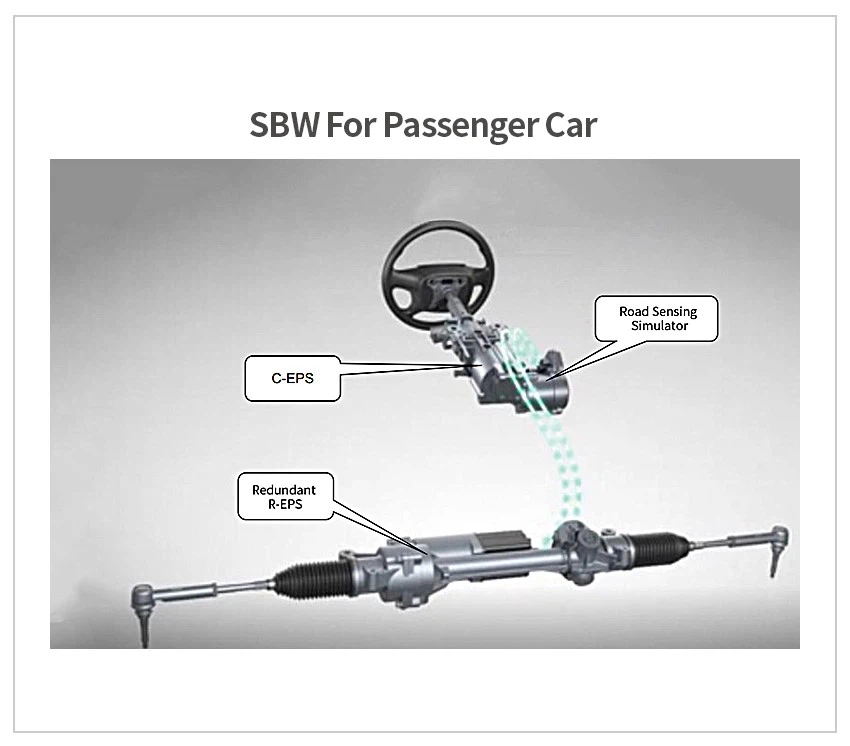
1. System Architecture: Two Core Modules
1.1. Steering Wheel Force Feedback Module
Components: Steering wheel, angle sensor (tracks wheel rotation), reducer (adjusts torque), road-sensing motor (simulates road feel), torque sensor (measures driver input), and current sensor (monitors motor load).
Role: Delivers tactile road feedback to the driver (e.g., rough terrain, tight corners), ensuring a natural driving experience—critical for safety and comfort in both manual and semi-autonomous modes.
1.2. Steering Execution Module
Components: Motor-driven wheel control (no mechanical linkages like steering columns or racks).
Role: Directly translates steering wheel angles to wheel movements, eliminating mechanical lag. Enables precise, responsive steering (e.g., quick lane changes, autonomous navigation).
2.Working Mechanism: Position Control + Force Feedback
2.1. Driver Input to Wheel Movement (Position Control)
Step 1: Driver turns the steering wheel. The angle sensor sends this signal to the steering execution module.
Step 2: The module’s motor adjusts wheel angle to match the input, ensuring accurate, delay-free steering (e.g., 90° wheel turn = 90° tire turn, no mechanical slop).
2.2. Wheel Data to Driver Feedback (Force Feedback)
Step 1: The execution module collects motor current (load) and wheel angle data, plus vehicle speed (from onboard systems).
Step 2: This data is processed by the road-sensing feedback unit (part of the force feedback module), which calculates realistic road torque (e.g., resistance on a gravel road).
Step 3: The road-sensing motor applies this torque to the steering wheel, letting the driver “feel” the road—even in an SBW system (no mechanical connection).
3.User Benefits: Safety, Comfort, and Innovation
3.1. Enhanced Safety
Precision: Eliminates mechanical errors (e.g., loose steering), improving stability at high speeds or during emergency maneuvers.
Redundancy Readiness: Integrates easily with autonomous systems (e.g., L3-L4), where wire-controlled steering is vital for sensor-driven safety (e.g., collision avoidance).
3.2. Comfort & Efficiency
Natural Feel: Drivers experience realistic road feedback, maintaining confidence in SBW-equipped vehicles (e.g., electric buses, autonomous shuttles).
Lightweight Design: No heavy mechanical parts reduce vehicle weight (boosting EV range) and simplify chassis packaging (ideal for low-floor buses or futuristic EV designs).
Products List


SBW System Control Strategy: Precision and Feedback for Safe Steering
For drivers and vehicle engineers, the steering by wire (SBW) system’s control strategy is pivotal. This drive by wire steering system (or steer by wire system) ensures accurate wheel movement while letting drivers “feel” the road, balancing safety and intuitive control. Here’s how it works, designed with user needs at the forefront.
1. Two-Way Control: Position + Force Feedback
1.1. Position Control: Accurate Wheel Tracking
How It Works: The system uses the difference between steering wheel angle (driver input) and front wheel angle (actual position). This gap guides the steering execution motor (part of SBW), ensuring wheels turn exactly as the driver intends. No mechanical lag—just precise, direct control (e.g., 30° wheel turn = 30° tire turn, perfect for parking or highway lane changes).
User Benefit: No guesswork in steering. Drivers know their input translates directly to wheel movement, reducing accident risks (e.g., in wet conditions, precise control avoids skidding).
1.2. Force Feedback: Road Feel Simulation
How It Works: The controller monitors steering motor current (which reflects road load, like a pothole or gravel). Using this, it calculates road resistance and rack force (steering system stress). This data is sent back to the steering wheel via the force feedback module, mimicking real-world feel (e.g., heavy steering on a steep hill, light on smooth tarmac).
User Benefit: Natural driving intuition. Even in SBW-equipped vehicles (e.g., electric buses with no mechanical linkages), drivers sense road conditions, maintaining confidence (e.g., in a delivery truck, feedback warns of uneven loads).
2. Why This Strategy Serves Users
2.1. Safety First
Real-Time Adaptation: Adjusts feedback for road conditions (e.g., ice, mud), helping drivers react faster (e.g., sudden tire slip? Steering wheel feedback alerts them to correct).
Autonomy Ready: Critical for L3-L4 self-driving (e.g., Robo-taxis), where SBW’s precision ensures sensor-driven safety (no mechanical errors to disrupt autonomous control).
2.2. Comfort and Efficiency
Intuitive Feedback: Seamless transition from traditional steering (e.g., in a rental EV with SBW, drivers feel at home immediately).
Energy Smart: Optimizes motor use (based on position/force), reducing power waste—ideal for EVs (extends range, cuts operating costs for fleets).

SBW System Road Feel Feedback Control Strategy
The road feel feedback unit of the steer-by-wire (SBW) system operates as follows:
Based on Current Road Conditions: Uses a dynamics model to analyze real-time scenarios (e.g., rough terrain, smooth tarmac).
Input Integration: Combines vehicle dynamic response (e.g., speed, tilt) and driver steering wheel input (angle, torque).
Rack Force Estimation: Reconstructs road resistance (e.g., gravel, uphill) and driver’s hand force feedback (how hard the driver turns the wheel).
Torque Calculation: Integrates with electric power steering (EPS) assist strategies to compute compensatory feedback torque (adjusts steering feel for safety/comfort).
Final Command: Generates the desired feedback torque instruction (e.g., heavier steering on steep hills, lighter on flat roads), ensuring the driver “feels” the road through the steering wheel.
This strategy ensures intuitive road awareness (critical for safety, e.g., detecting slippery surfaces) and consistent handling (e.g., stable cornering in EVs with SBW), enhancing both manual and autonomous driving experiences.
L4 SBW system design features
| Level | Functional features | Functional safety requirements | Quality system standards | Vehicle electrical architecture | Software architecture |
| L4 | steer-by-wire + road feel simulation | ASIL-D | 16949+ASPICE-4 | centralized domain controller | autosar |
| Steering control hardware architecture requirements | |||||
| Motor | Main control chip | Sensor redundancy | Power drive | Power supply | Communication |
| 6-phase brushless | (function + lock-step core)*2 |
Steering wheel angle*2 motor angle*2 |
Drive circuit redundancy | Dual power supply | CAN-FD+CAN |
| Road sense simulation architecture requirements | |||||
| 6-phase brushless | (function + lock-step core)*2 | Torque*4, steering wheel angle*2, motor angle*2 | Dual drive circuits | Dual power supply | CAN-FD+CAN |
Fully redundant R-EPS basic structure

outer tie rod
Redundant PPK
Angle sensor
Redundant R-EPS overall parameters
| Item | Technical Parameters |
| Rack thrust | 16000N |
| Number of turns | 3±0.1 turns |
| Stroke | 162±1mm |
| Sensor type | Torque sensor or angle sensor (wire control) |
| Protection level | IP67 or IP69K |
| Motor type | Brushless motor |
| Rated voltage | 12V |
| Motor rated power | 950W |
| Power supply current | 120ADC |
| Motor rated torque | 7.2N·m@1250rpm |
| Maximum speed | 4000rpm |
PPK solution for steering by wire
Redundancy Backup Approach for the Execution Layer of Intelligent Driving Chassis
1. Current EPS Redundancy in Human-Driven Scenarios
The electric power steering (EPS) system has two parts: electronic control (e.g., ECU, sensors) and mechanical structure (e.g., steering column, rack).
Backup Mechanism: If the electronic control fails (e.g., sensor error, ECU malfunction), the driver uses the mechanical structure (steering column) to manually steer, acting as a redundancy backup (e.g., in a traditional car, you can still steer with a faulty EPS motor by physical force).
2. Challenges in Unmanned (Autonomous) Scenarios
No Human Intervention: In L3-L4 autonomous driving (e.g., Robo-taxis, driverless trucks), there’s no driver to use the mechanical backup.
Critical Failure: If the EPS electronic control fails (e.g., in a self-driving bus), the mechanical structure can’t be activated (no human to turn the wheel), leading to complete steering loss—a safety risk.
3. Need for Advanced Redundancy in Intelligent Chassis
Electrical/Software Redundancy: Modern solutions (e.g., dual ECU, redundant sensors, 6-phase motors) ensure no single-point failure (as seen in SBW systems for autonomous vehicles).
Example: A steer-by-wire (SBW) system with dual power supplies, redundant motors, and fail-safe software (e.g., AUTOSAR-compliant ECU with backup logic) can handle electronic failures without relying on human input, critical for autonomous safety.

√ Two sets of windings are decoupled from each other and the control is simple
√ Double-layer control has good synchronization and fast response
√ 50% power is retained when one side fails;
√ Low cost, small size, easy to arrange.

√ Redundant communication chip, dual ECU private CAN communication;
√ Redundant main chip, dual MCU;
√ Redundant motor MOSFET drive bridge, dual pre-driver.

4+2 (4 Touque+2 Angle)
√Motor rotor position chip redundancy
√ Meets ASIL D requirements

√ Achieve the comprehensiveness, reliability and stability of redundant control.
FAQ
Q: What is Steering By Wire?
A: Steering By Wire is a technology that replaces traditional mechanical or hydraulic steering systems with electronic controls. It uses sensors, actuators, and electronic signals to control the steering mechanism, allowing for more precise steering control and the elimination of physical connections.
Q: What are the advantages of Steering By Wire?
A: - Improved Precision: Offers greater control and responsiveness.
- Weight Reduction: Eliminates the need for physical components, reducing the overall weight of the vehicle.
- Design Flexibility: Allows for innovative vehicle designs without constraints of mechanical linkage.
- Enhanced Safety: Can be integrated with advanced driver-assistance systems (ADAS) and enable features like automatic steering corrections.
- Customizable Driving Experience: Settings can be adjusted for different driving modes (comfort, sport, etc.).
Q: Are there safety concerns associated with Steering By Wire?
A: As with any technology, safety is a consideration. Steering By Wire systems utilize multiple redundancies and fail-safe mechanisms to ensure that if one component fails, the steering function can still operate safely. Manufacturers rigorously test these systems to comply with automotive safety standards.
Q: How does Steering By Wire work?
A: In SbW, the driver’s input at the steering wheel is captured by sensors, which then send electrical signals to a computer system. The computer processes the signals and sends commands to motors or actuators at the wheels to control steering direction.
Q: How does Steering By Wire impact vehicle maintenance?
A: Steering By Wire systems may require less maintenance than traditional systems due to fewer moving parts. However, technicians will need specialized training to diagnose and repair electronic components.
Q: Can Steering By Wire systems fail?
A: Like all electronic systems, there is a possibility of failure. However, SbW incorporates redundancies and safety features to mitigate risks, ensuring dependable operation even in the event of some component failures.
Q: Is Steering By Wire currently available in commercial vehicles?
A: Yes, several manufacturers are implementing Steering By Wire technology in both electric and conventional vehicles, particularly in higher-end models and electric vehicles where weight saving is crucial.
Q: What impact does Steering By Wire have on the driving experience?
A: SbW can provide a unique and customizable driving experience. It can offer variable steering ratios, enhanced feedback, and can be tailored for different driving conditions, contributing to improved handling and comfort.
Q: Is Steering By Wire compatible with autonomous driving technologies?
A: Yes, Steering By Wire systems can be easily integrated with autonomous driving technologies, providing a seamless interface for the vehicle's automated systems to control steering based on real-time data and algorithms.
Q: What happens if there is a power failure in a Steering By Wire system?
A: Steering By Wire systems are designed with fail-safe features. In the event of a power failure, backup systems may allow the driver to retain control of the vehicle or the system can default to a safe mode.
We're professional steering by wire manufacturers and suppliers in China, specialized in providing high quality customized service. We warmly welcome you to wholesale cheap steering by wire for sale here and get pricelist from our factory. For price consultation, contact us.
steering by wire efficiency, steering by wire, advanced steering by wire