


Commercial Vehicles GSR Solution
OEM-grade General Safety Regulation solution integrating BSIS, MOIS, DDAW, ISA and LDWS functions, engineered for commercial buses, trucks and specialty vehicles with seamless CAN-bus integration and EU homologation support.

01
Covers M2, M3, N2 and N3 commercial vehicle platforms
02
All-in-one host units with matched cameras and audiovisual alarm
03
Customizable mechanical interfaces, CAN protocols and alarm strategies
04
Full-cycle support from calibration and pre-testing to homologation submission
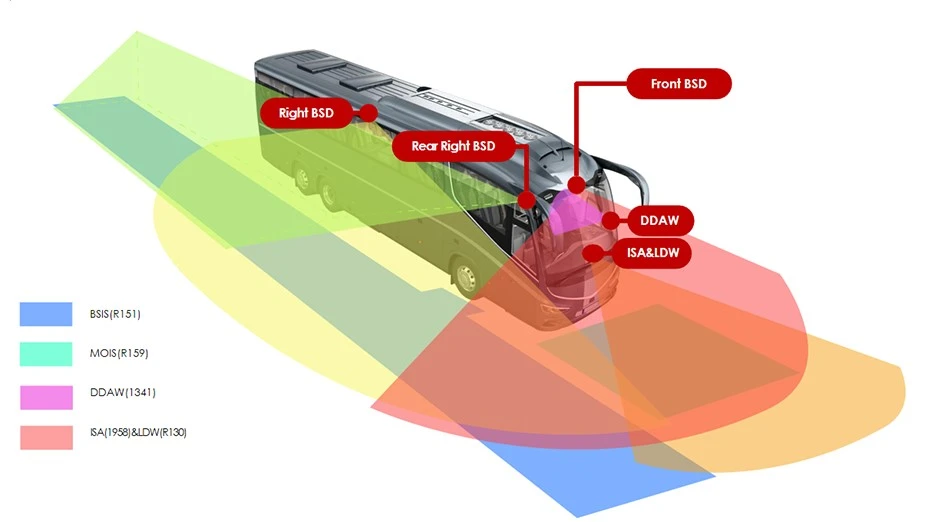
GSR Solution Overview
Our GSR (General Safety Regulation) solution is an integrated active-safety package developed for commercial vehicles entering the EU market. It combines in-cab driver monitoring, surround-view perception cameras, a dedicated GSR host unit, an audiovisual alarm and a map device, exchanging data with the vehicle through the CAN bus. The solution addresses mandatory safety functions including blind-spot detection, moving-off warning, driver drowsiness and attention warning, intelligent speed assistance and lane departure warning, and can be tailored to specific OEM platforms, installation layouts and interaction requirements.
Applicable Regulations & Vehicle Types
|
Regulation |
Function |
Vehicle Category |
Market |
Detected Target |
Speed Range |
|
UN R151 |
BSIS — Blind Spot Information System |
M2, M3, N2, N3 |
EU member states |
Cyclists |
0–30 km/h |
|
UN R159 |
MOIS — Moving Off Information System |
M2, M3, N2, N3 |
EU member states |
Pedestrians & cyclists (adults, children) |
0–10 km/h |
|
Reg (EU) 2021/1341 |
DDAW — Driver Drowsiness and Attention Warning |
M, N |
EU member states |
Driver |
>70 km/h |
|
Reg (EU) 2021/1958 |
ISA — Intelligent Speed Assistance |
M, N |
EU member states |
Explicit & implicit speed signs |
0–130 km/h |
|
UN R130 |
LDWS — Lane Departure Warning System |
M2, M3, N2, N3 |
EU member states |
Lane markings |
>60 km/h |
|
Reg (EU) 2023/2590 |
ADDW — Advanced Driver Distraction Warning |
M, N |
EU member states |
Driver distraction |
Expandable from DDAW |
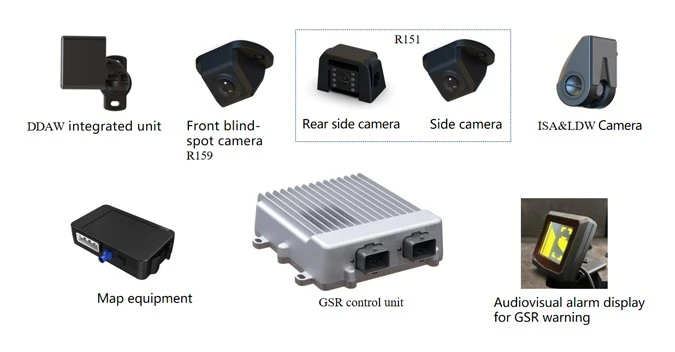
The platform combines host units with dedicated cameras and an alarm device, connected over the vehicle CAN bus.
MONO C3 — in-cab DDAW / ADDW monitoring unit
TD320 — GSR host unit for BSD, MOIS, BSIS, LDW and ISA functions
Surround-view cameras — front, right-side, rear-right and ISA/LDW cameras
Audiovisual alarm — optical and acoustic warning to the driver
Map device — provides map and GPS data for ISA fusion
Core Safety Functions
DDAW & ADDW
The DDAW unit monitors driver drowsiness and attention and triggers an audiovisual warning when fatigue indicators are detected. ADDW can be enabled as a seamless upgrade from the same DDAW camera, covering distraction detection across the defined cabin areas. Acceptance criteria follow the regulation trigger regions: above 50 km/h, warning within 3.5 seconds; above 20 km/h, warning within 6 seconds; test points are distributed across the cabin, with false positives controlled within the allowed limit.
ISA — Intelligent Speed Assistance
The ISA solution fuses camera-based traffic-sign recognition with map and GPS data. Per EU recommendations, a camera-plus-map fusion approach is adopted; a map-only solution is not permitted. The system recognizes both explicit signs (speed limit, zone, motorway, built-up area, living street, cycle street and their end markers) and implicit signs derived from map and road context, then provides optical and acoustic warning when the speed limit is exceeded.
LDWS — Lane Departure Warning
The LDWS identifies straight-lane departures and departures on curves with a radius greater than 250 m. A warning is triggered within 0.3 m after the outer contour of the front wheel fully crosses the lane line.
BSIS (UN R151) & MOIS (UN R159)
BSIS monitors cyclists in the side blind spot at low speed, while MOIS detects pedestrians and cyclists — including adults and children — around the vehicle during moving-off maneuvers. Both functions run on the GSR host unit with dedicated surround-view cameras.
OEM Customization & Integration
Mechanical interfaces: mounting dimensions, positions and connectors adapted to the OEM vehicle
CAN protocol: instrument and alarm interaction, fault-warning mechanisms defined with the OEM
Performance tuning: adjusted to payload and operating conditions; function switches, harnesses and alarm strategies are customizable
Joint development: coordinated with the vehicle VCU, e-axle, braking and steering systems; cybersecurity requirements are defined at the development stage

Calibration & Production Support
Target calibration: matched calibration targets and alignment procedure
Road calibration: fishbone lines, zebra crossings, direction guide lines, lane indicator lines and OEM-specified markings
Production-line tool: bilingual (Chinese / English) offline calibration and check tool for OEM plants
Commercial-vehicle parts focus with multi-model GSR homologation experience
In-house host units and cameras, with integrated hardware harness and software protocol delivery
Full-cycle support on certification documents, institute liaison and on-site engineering
Flexible capacity from prototype trial to mass production
Frequently Asked Questions
Q1. Which GSR functions does your solution support for commercial vehicles?
+
-
A: The solution supports BSIS (UN R151), MOIS (UN R159), DDAW (Reg (EU) 2021/1341), ISA (Reg (EU) 2021/1958) and LDWS (UN R130). ADDW (Reg (EU) 2023/2590) can be expanded from the DDAW camera.
Q2. Which vehicle categories are covered?
+
-
A: The system is designed for M2, M3, N2 and N3 commercial vehicles, including electric city buses, coaches, heavy-duty trucks, logistics vehicles and specialty commercial vehicles.
Q3. Can the DDAW camera be upgraded to ADDW later?
+
-
A: Yes. ADDW is enabled as a seamless software expansion from the existing DDAW camera, without requiring a separate cabin sensor.
Q4. Does your ISA use camera-only or camera-map fusion?
+
-
A: The ISA system uses camera-plus-map fusion, combining visual sign recognition with map and GPS data. A map-only approach is not used, in line with EU recommendations.
Q5. Do you support OEM customization?
+
-
A: Yes. Mechanical interfaces, mounting positions, CAN protocols, harnesses, connectors, instrument and alarm interaction, and fault-warning mechanisms can be customized to the OEM vehicle specification.

Custom GSR Solution for Commercial Electric Vehicles
OEM-grade General Safety Regulation solution integrating BSIS, MOIS, DDAW, ISA and LDWS functions, with EU homologation and integration support.
We're professional commercial vehicles gsr solution manufacturers and suppliers in China, specialized in providing high quality customized service. We warmly welcome you to wholesale cheap commercial vehicles gsr solution for sale here and get pricelist from our factory. For price consultation, contact us.